





Ferrite permanent magnets are produced by the powder metallurgy method from fine powders containing compositions of the type (Ba,Sr,Pb)O.6Fe2O3.
In terms of mechanical and electrical characteristics, oxide magnets resemble ceramics. Their specific electrical resistance is about 108Ω.cm. Mechanically, they are very brittle and hard, so additional mechanical processing is usually avoided or diamond tools are used.
What is special about their magnetic characteristics is their high coercivity and relatively low residual magnetization. In order to be magnetized, an external field of more than 800 kA/m must be applied. The Curie point is 450°C, the maximum operating temperature is up to 250°C, and the temperature coefficient of change of Br and Hc is 0.2 %/°.
The characteristics of the barium and strontium ferrites offered by us are given in the table.
|
MATERIAL |
Typical values |
||||||||
|
(B.H) max |
Br |
BHc |
JHc |
||||||
|
kJ/m3 |
MG.Oe |
T |
G |
kA/m |
Oe |
kA/m |
Oe |
||
|
Hfer 6/19 |
i
|
6 |
0.75 |
0.17 |
1700 |
104 |
1300 |
190 |
2400 |
|
Hfer 8/22 |
i
|
8 |
1.0 |
0.21 |
2100 |
136 |
1700 |
220 |
2750 |
|
Hfer 30/22 |
a
|
30 |
3.8 |
0.38 |
3800 |
180 |
2300 |
220 |
2750 |
i – isotropic
a – anisotropic
The magnetic characteristics of isotropic ferrite magnets do not depend on the direction and method of magnetization. They are suitable for multi-pole magnetization with a complex configuration.
The magnetic characteristics (strength) of anisotropic ferrite magnets depend on the direction of magnetization. During their production, a direction is set in which their magnetic characteristics are higher. It is in this direction that these magnets are magnetized and used.
For comparison, the adhesion force of anisotropic ferrites is up to 3 times greater than that of isotropic ones.
 Cylindrical neodymium magnets
 Block Neodymium Magnets
 Neodymium magnets with screw hole
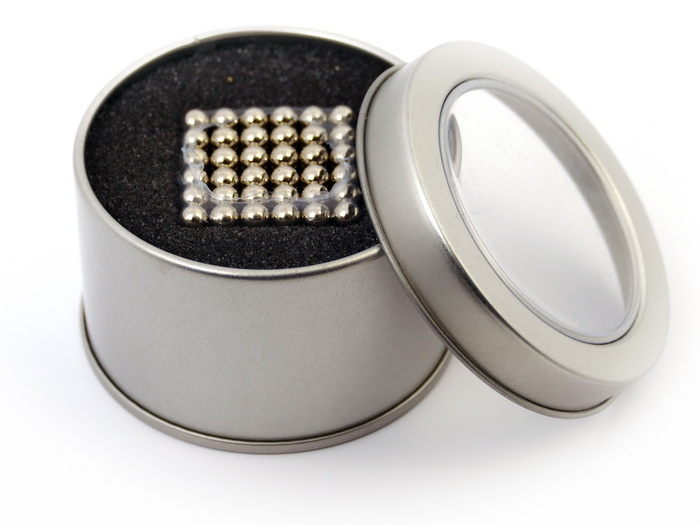
 Neodymium balls
 С друга форма Неодимови магнити