






FAQs
This is the force you need to apply to peel the magnet off a thick (e.g. 20 mm), smooth (polished) iron plate (technically pure iron). This force IS NOT a magnetic characteristic of the material, nor is it even a characteristic of the magnet. It only allows you to roughly compare the capabilities, in terms of attraction and repulsion, of magnets of different sizes, shapes and materials.
For the same magnet material, this force depends on:
For specific situations in which you will use magnets, you can contact us for advice. In most cases, a sample (experiment) will give you the most accurate answer to the question “What is the adhesion force?” for the specific application.
The possible magnetization methods (pole configurations) of magnets are given below. In the case of anisotropic magnets, the direction of magnetization is set during the manufacturing process. Therefore, they are available magnetized only in a certain way (in a fixed direction or axis). Such are neodymium magnets and anisotropic ferrites (Hfer30/22). Isotropic magnets are suitable for one-sided, two-pole and multi-pole magnetization. Ferrite magnets of the type (Hfer8/22) and magnetic foil are isotropic. Isotropic AlNiCo and neodymium magnets can also be manufactured, but in this case their magnetic characteristics are significantly lower.
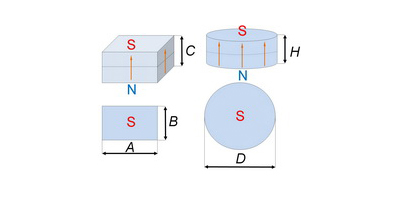
Bipolar axis H or C
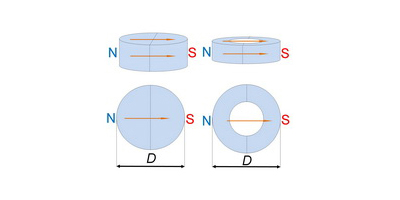
Bipolar, diametrical

Bipolar, one side
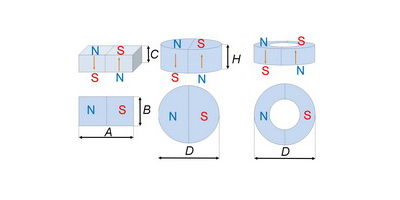
Bipolar, on both sides
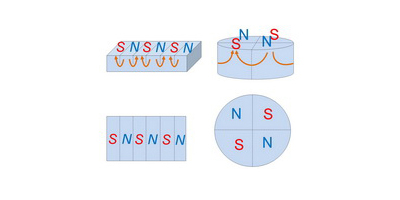
Multipolar (strip, sector), on one side
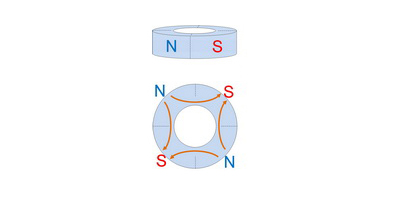
Multipole on the surrounding surface
(for cylindrical and ring magnets)
Yes, this is completely true for magnets magnetized “bipolarly along the H axis” and functionally you will not find any difference between the two options.
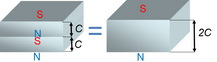
The rule applies with great accuracy to 3,4,5, etc. magnets, but as the number increases, the accumulating air gap between the magnets may begin to have an impact. For other methods of magnetization, in most cases the above rule is inapplicable.
Although they appear unchanged, over a long period of time, magnets partially lose their magnetization.
This happens to different degrees for different types of magnets.
AlNiCo magnets are the most resistant, both in terms of time and repeated temperature changes during operation. If they are not subjected to strong external magnetic fields, the change in about 30 years is no more than 2-5%.
Neodymium magnets are the most resistant to strong external magnetic fields and at constant room temperature they rival AlNiCo in resistance. Unfortunately, they are very sensitive to temperature changes, especially near and above the maximum operating temperature.
Ferrite magnets are the most noticeably demagnetized over time. They change their magnetization significantly with temperature changes (but can operate at significantly higher temperatures than neodymium magnets). However, in cases where a change of 10-15% is not significant, they can be used for practically an unlimited time.
 Cylindrical neodymium magnets
 Block Neodymium Magnets
 Neodymium magnets with screw hole
 Neodymium balls
 another shape – Neodymium magnets